Our Migration Journey
We came to Australia in 2017 through the skilled migration program. My journey actually started back in 2014 when I began taking English exams. To register as a nurse in Australia, IELTS required a score of minimum 7 in all band—not just an overall average of 7. I tried three times but kept falling short, can only get 6.5 in writing and speaking.
Eventually, I switched to the Occupational English Test (OET). That wasn’t easy either—I had to sit for it three times before finally passing. After that, I applied for my Australian nursing registration as well as skilled migration. I was very lucky: the The Australian Health Practitioner Regulation Agency recognized my qualifications from Hong Kong, so I didn’t need to do a bridging course.
All in all, it took me two years just for the English tests, and another year for the migration process itself—applying for skilled migration, getting my nursing license, doing the health check, and obtaining police clearance. From start to finish, it took three years before we finally secured our permanent residency (PR). All the cost including visa fees alone was about AUD 20,000.
PR is almost the same as being a citizen in terms of rights and benefits. The main differences are that citizens can vote and hold an Australian passport but not for PR. To apply for citizenship, people need to live in Australia for four years, with at least one year of that as a PR. We lodged our application in 2021, and by November 2022, we officially became Australian citizens.
Migration history of “Australia”
Since the 18th century, when Captain Arthur Phillip first set foot on the Australian continent, Australia has always been a nation shaped by migration. Back in the 1700s, Britain sent convicts here. Then came the Gold Rush in the mid-19th century, attracting waves of migrants—not just from Britain and Europe, but also from China and even the United States.
By the time Australia became a federation in 1901, right up until World War II, the country enforced what was known as the White Australia Policy. This meant immigration was restricted almost exclusively to people from Britain. Even Europeans from non-English-speaking countries, like Germany and Italy—despite being “white”—were not allowed to migrate to Australia during that time.1

After World War II, Australia began to relax its immigration policies. Between 1945 and 2010, around 6.5 million people moved to Australia. This wave of newcomers transformed the country into one of the world’s major immigrant nations. 2

Before COVID hit in 2019, Australia was welcoming roughly 200,000 new migrants each year. At that time, about 29.4% of the permanent population—around 7.3 million people—were born overseas. By 2024, that figure had risen to around 31.5%, or about 8.6 million people. In other words, in just five years, the number of foreign-born residents grew by an extra 1.3 million.
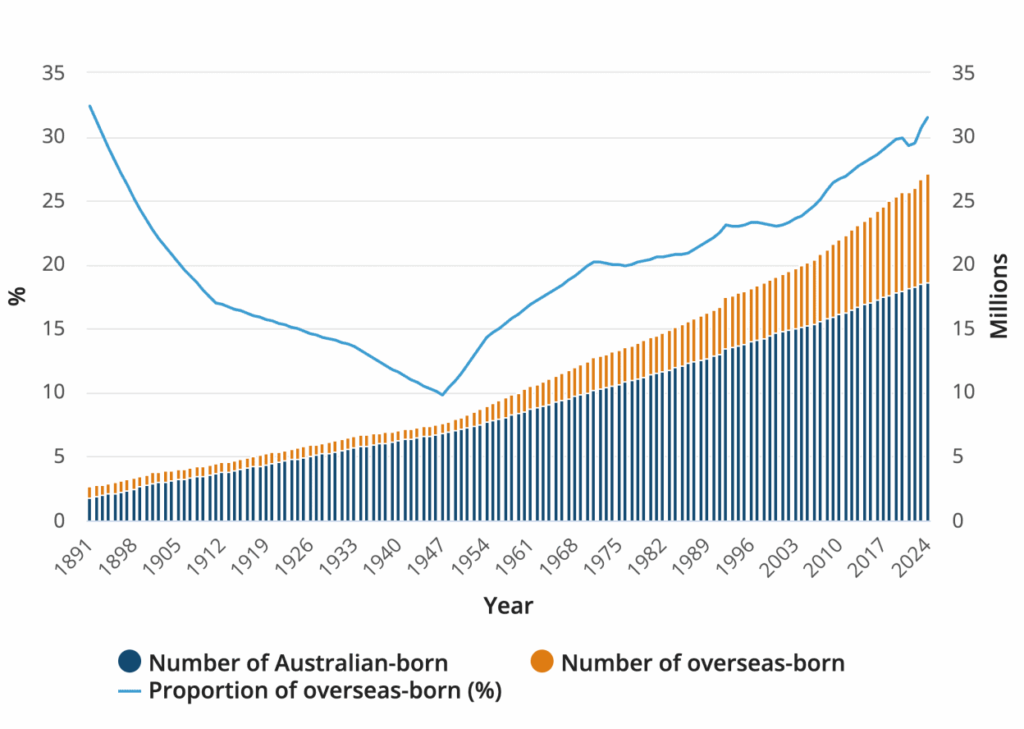
Since the Labor government came to power just over three years ago, immigration numbers have hit record highs—more than 1.2 million people have moved to Australia.
It’s said that several hundred thousand of them are on temporary visas (non-tourists). But people on temporary visas still need housing, transport, and medical care.

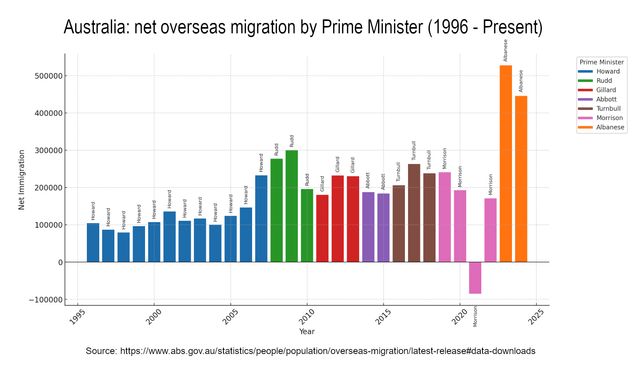
With such a sharp rise in population, it’s no surprise that housing, transport, and healthcare are under pressure. Property prices in the major cities have reached record highs, and even rising interest rates haven’t been enough to cool the market.
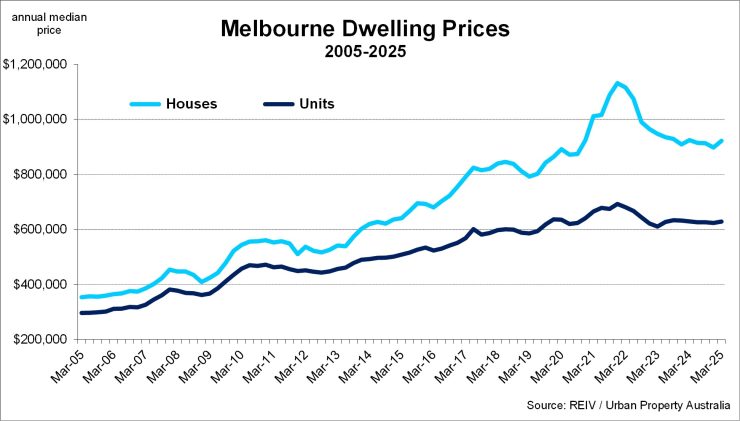
Take Melbourne, for example. These days, a detached house will set you back at least $1 million, while units and townhouses go for around $800,000. I still remember when we first arrived in Melbourne—back then, you could find detached houses in our area for around $800,000. Now, those same properties are selling for $1.1 to $1.2 million. And Sydney? The prices there are even more extreme.

If you’re curious, you can check mortgage details on major bank websites. For example, a family of four with both parents working full-time and a pre-tax income of $200,000. With a 32% tax rate, their actual take-home pay is about $11,000 per month.
If they borrow $800,000 over 30 years at 5.6% interest, their monthly repayments would be around $4,600—almost 40% of their total income. For a 30-year-old couple, making sure they earn $200,000 every year for the next 30 years is a huge financial pressure.
The theme of this march is opposition to immigration. Participants believe that too many immigrants are putting pressure on housing, transport, and healthcare.
Surprisingly, 80-year-old Queensland MP Bob Katter became one of the main figures in this march. He strongly supports the anti-immigration protest. When a reporter asked him about his grandfather being Lebanese, he reportedly flew into a rage.3


“Do you see them mixing with other Australians? Dressing like other Australians? Being friendly with other Australians? Being in the local Lions Club? Do you see that?” he asked.
“You don’t want to become an Australian, you got to get the hell out of this country.”
“I’m an Australian, my family has been here since the dawn of time, that’s the end of it.
“Even if my family had only been here 10 minutes, no one has the right to say what he just said. 4
It seems like as long as we Asians join the Lion Club and wear the Australian “cowboy hat” (the Akubra), they’re considered Australians. Really? Of course, we’ll never quite pick up the strange Australian accent, have blue eyes and gold hair.
Far-right ideology
Besides “everyday life” issues, racism and skin color were also part of the march’s themes, with slogans like “Protect White Heritage.”

In an X space on 11 August (where live audio conversations occur on the X platform), Bec said messaging should follow certain steps:
“So, protect Australian heritage, culture, way of life. Next step, protect European culture, heritage, way of life. The next step is protect white heritage. So it all means the same thing.
In response to questions from Guardian Australia about the comments, Bec said:
“Am I a nationalist? Yes. Am I white? Yes. So I guess I’m a White Nationalist.”5 6
Another person involved in organizing this march is Hugo Lennon, AKA Auspill, who is a far-right supporter. Ironically, his grandfather was one of Western Australia’s major property developers, ranked among the state’s 50 richest people, with a fortune of about 500 million Australian dollars.7

He probably knows that without a large number of immigrants, his family’s wealth wouldn’t be what it is.
Although many of the march participants deny being racist and try to distance themselves from far-right groups like the Neo-Nazis, the founder of the Neo-Nazi group, Thomas Sewell, actively became a leader of the Melbourne march and even spoke in front of the Melbourne Parliament.8 9

Even if the original purpose of such marches is to protect Australia and show patriotism, they are often hijacked by other people or groups, which leads to all participants (around 8,000 in Melbourne this time) being labeled as far-right Nazis. The same happened in Hong Kong in 2019, and it’s the case with this March for Australia as well.
If we look back at Nazism in the 1930s, one of the things Adolf Hitler promoted was propaganda, which is similar to what some people at this march are doing.
Nazi ideology at its very core was racist and antisemitic, and its leaders considered Germany’s Jews to be a “foreign” race that had no place in the new Germany. Even Jews who had converted to Christianity could not be a part of the national community. 10
Blut und Boden (Blood and Soil)
Blood referred to the goal of a “racially pure” Aryan people. Soil invoked a mystical vision of the special relationship between the Germanic people and their land.
Government-sponsored racist propaganda was widely distributed denouncing Jews as “alien,” and “parasitic,” and responsible for Germany’s cultural, political, and economic “degeneration.” 11
The Nazis promoted antisemitic conspiracy theories. They adopted the common antisemitic practice of wrongly blaming Jews for society’s problems. The Nazis blamed Jews for Germany’s defeat in World War I (1914–1918); for communism; and for Germany’s economic problems. 12
Blaming immigration rather than the government or politicians for domestic housing and economic problems? That feels eerily similar to what the Nazis did back then.😼。
In reality, immigrants—whether skilled visa holders, temporary visa holders, student visa holders, or refugees—are simply entering Australia legally under the government’s immigration policies. If skin color is the focus of discussion, a more accurate description would be “the white Australian government”: about 75% of members of parliament are Australian-born, and if you look at ethnicity, only around 10% are non-European.
Most importantly, this government was actually elected by Australians. In the recent 2025 Federal Election, the Labor Party led by Albanese received over 5.3 million votes, 420,000 more than their Liberal opponents. These are representatives chosen by the people—who can really be blamed? (we submitted informal / blank votes).
The most ironic scene was that after participating in the anti-immigration march, the protesters went to a Chinese-style YUM CHA restaurant instead of a Western café for coffee. Truly ironic.

This time, the anti-immigration seems to target on Indians. In recent years, I have also noticed that there are indeed more Indians in Australia. According to 2023 statistics, there are 850,000 Indian-born immigrants in Australia—more than double the number from 10 years ago—making them the second-largest group in Australia (excluding the British), even more than people from mainland China, who number about 650,000.
Looking at the data further, the fastest-growing group over the past 10 years has actually been Nepalese, increasing from 34,000 to 180,000—more than a fivefold increase.13
But that doesn’t mean other groups won’t be targeted. Who can guarantee that the next anti-immigration campaign won’t target on Chinese ?

ABC News found that the March for Australia website originally listed several agenda items, one of which was “remigration,” meaning deporting immigrants. It was removed later. 14
Far-right groups often advocate for remigration. 15,This seems eerily similar to what the Nazis did back then.
At my workplace, half the staffs are Chinese, the rest are Indians and a few native-born white Australians. I really wonder—if we were all deported, could this country still function? Could these people still live their lives?
Sources:
- https://www.nma.gov.au/defining-moments/resources/white-australia-policy ↩︎
- https://en.m.wikipedia.org/wiki/White_Australia_policy ↩︎
- https://www.9news.com.au/national/bob-katter-punch-australian-politician-threatens-to-punch-journalist-calls-for-consequences-national-news/8725b7d2-d3f0-41a7-935b-ba8fe4d972a1 ↩︎
- https://www.abc.net.au/news/2025-08-28/bob-katter-threatens-journalist-lebanese-heritage/105706854 ↩︎
- https://www.theguardian.com/australia-news/2025/sep/02/how-neo-nazis-used-the-shield-of-ordinary-mums-and-dads-at-australia-anti-immigration-rallies-to-sell-white-supremacy-ntwnfb ↩︎
- https://www.smh.com.au/national/nsw/white-australians-and-neo-nazis-who-s-behind-anti-immigration-rally-20250826-p5mq2w.html ↩︎
- https://www.news.com.au/national/victoria/news/antimigration-coordinators-wealthy-property-family/news-story/caf85d8ef60ef5d7c8b2c771822b05fa ↩︎
- https://www.theguardian.com/australia-news/2025/sep/02/how-neo-nazis-used-the-shield-of-ordinary-mums-and-dads-at-australia-anti-immigration-rallies-to-sell-white-supremacy-ntwnfb ↩︎
- https://www.theage.com.au/national/victoria/neo-nazis-lead-violent-anti-immigration-march-as-clashes-break-out-with-counter-protesters-in-cbd-20250831-p5mr8y.html ↩︎
- https://exhibitions.ushmm.org/propaganda/1918-1933/hitler-nazi-propaganda ↩︎
- https://www.ushmm.org/antisemitism/what-is-antisemitism/origins-of-neo-nazi-and-white-supremacist-terms-and-symbols ↩︎
- https://encyclopedia.ushmm.org/content/en/article/antisemitism-1 ↩︎
- https://www.homeaffairs.gov.au/research-and-statistics/statistics/country-profiles/profiles ↩︎
- https://www.abc.net.au/news/2025-08-28/who-is-behind-march-for-australia-anti-immigration-rallies/105657548 ↩︎
- https://www.theguardian.com/world/2024/oct/03/how-remigration-became-a-buzzword-for-europes-far-right ↩︎